
Blog · Card Meanings · November 4, 2026
Mars Oracle Card Meaning: A Word-Keeping Audit for Today
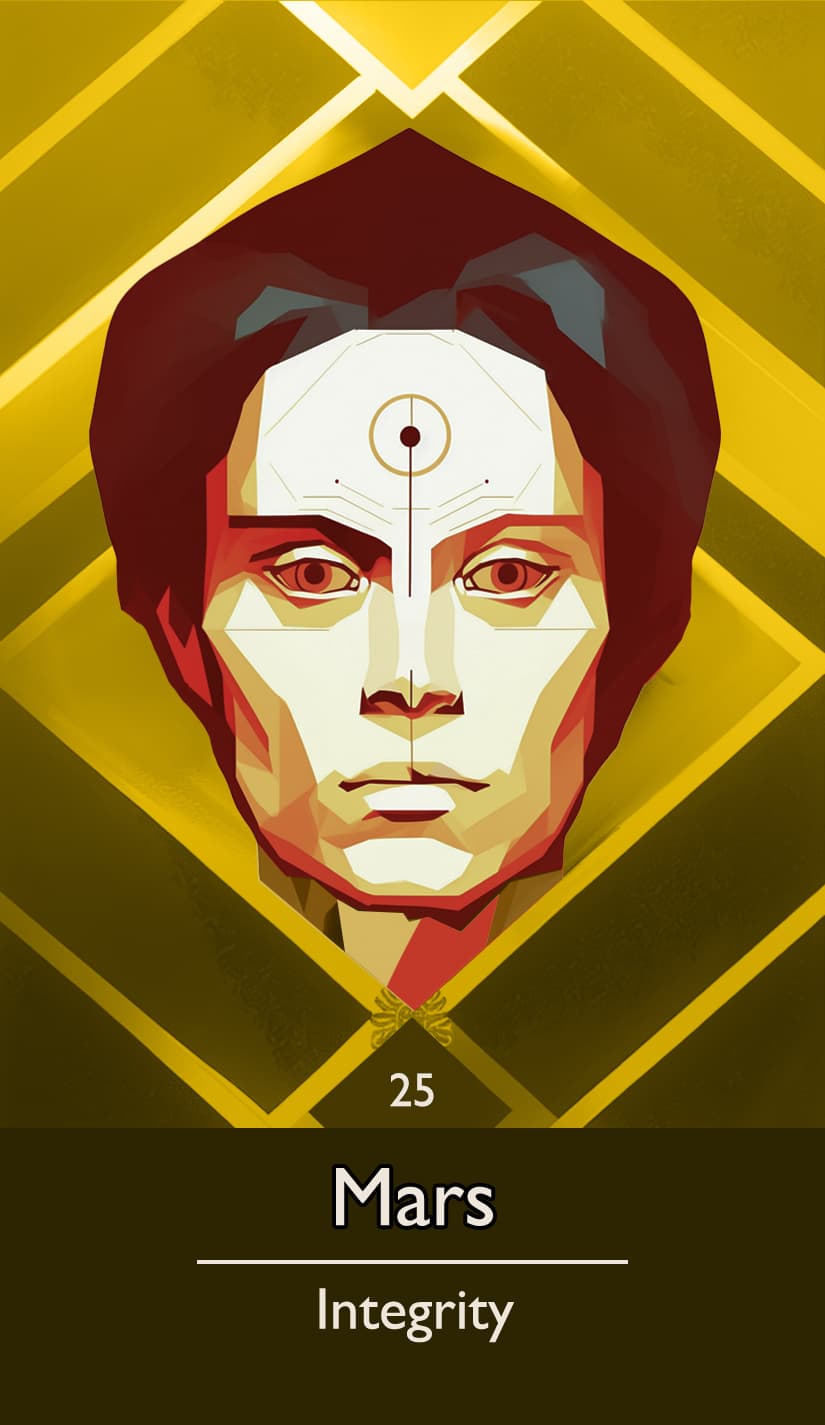
What Does the Mars Oracle Card Mean?
The Mars oracle card means integrity: being honest and standing true to yourself, especially when no one is watching. Its question for the day is simple: where does what you say, what you do, and what you believe not line up?
Don't read the card as a war card. Mars here isn't about aggression or winning. It's about alignment. The core message is that your word is your most valuable asset, and every small compromise spends some of it.
The card doesn't predict anything. It doesn't say you've done something wrong, and it doesn't promise a reward for doing right. It points a flashlight at one spot and asks you to look.
The Three Kinds of "Your Word"
Most people hear "keep your word" and think only of promises to other people. The card is wider than that. Your word shows up in three places.
- Promises to others. The "I'll call you Thursday." The "Yeah, count me in." The deadline you agreed to without checking whether you could hit it.
- Promises to yourself. The 6 a.m. workout you set for. The drink you said you'd cut back on. The conversation you said you'd have by the end of the month. These are the easiest to break because no one else keeps score.
- The story you tell about yourself. What you say you value, what you say you're like, what you say you'd never do. If your calendar and bank statement tell a different story, that's a gap.
The second and third are where the "no one is watching" line applies. Integrity that only works under observation is reputation management. The card asks about the other kind.
How to Read Mars in a Daily Draw
A single card gets its meaning from the day you pull it. Here are three common situations and how Mars tends to read in each.
You drew it before a decision
Mars is asking whether the option you're leaning toward is one you could explain out loud without editing. If you're already rehearsing the version of the story that leaves something out, that's your answer to look at. The card doesn't pick for you. It asks if you can make the choice and keep your own respect.
You drew it after a slip
Sometimes you pull Mars the morning after you shaded the truth, ghosted someone, or let a lie of omission stand. In that case the card is a prompt to name it plainly, to yourself first. No drama and no self-punishment. Just the accurate sentence: "I said X, I did Y."
You drew it on a day when nothing feels wrong
This is the most useful draw, honestly. Integrity drift is quiet. It rarely arrives as a big betrayal. It comes as a dozen small things you've stopped noticing: the padded estimate, the "sounds good" you didn't mean, the corner you cut because it's only you who'll know. A calm day is a good day to go looking.
What Integrity Is Not
Two misreadings are worth heading off.
It's not perfection. Everyone has gaps between values and behavior. The card isn't asking you to be flawless. It's asking you to notice the gap and close it when you can, rather than defend it.
It's not bluntness as a virtue. Being honest doesn't mean saying every thought out loud. It means that what you do say is true, and that you don't act against what you know. You can be honest and still be kind about timing and delivery.
The Homework: Find One Area, Take One Step
The deck's assignment is specific: identify one area where you've compromised your integrity, and take one step to realign this week. One area, one step. Resist the urge to audit your whole life in an afternoon. Here's a simple way to do it.
Step 1: Run a five-minute scan
Take a piece of paper and finish these three sentences, fast and without editing:
- "Something I told someone I'd do and haven't is..."
- "Something I told myself I'd do and keep dodging is..."
- "Something I say about myself that my actions don't back up is..."
You'll likely get at least one answer without trying. The one that makes you want to skip ahead is usually the one the card means.
Step 2: Pick the one with the most weight
Not the easiest, and not the most dramatic. Pick the one where closing the gap would feel like setting down something heavy. Circle it.
Step 3: Choose the smallest honest step
A realigning step can be small and still count. Some examples:
- Send the message you owe someone, even if it's "I haven't done this and here's when I will."
- Renegotiate a commitment you can't keep, rather than letting it quietly die.
- Correct a number, a story, or an impression you let stand.
- Do the thing you promised yourself, for ten minutes, today.
- Stop making a promise you already know you won't keep.
Notice that "renegotiate" and "stop promising" are legitimate moves. Integrity doesn't require you to keep every promise at any cost. It requires that you tell the truth about the ones you can't.
Step 4: Put a day on it
Write down when you'll do it. "This week" is easy to slide past. A named day gives the step an edge.
A Short Evening Check
At the end of the day, ask yourself one question: "Did what I did today match what I said?" If yes, good. If not, no need to turn it into a trial. Write down the gap and decide the next move. Over a few days this builds a habit of noticing, and noticing is most of the work. If you want to keep a record, your past readings make a decent running log of what each card brought up.
When Guilt Gets Heavy
The card is about reflection and realignment, not about piling on shame. If what surfaces is heavy, such as a pattern you can't shake or guilt that follows you around, a counselor or therapist is the right person to talk to. A card can start a thought, but it isn't a substitute for professional support.
The Takeaway
Your word is the thing people use to decide whether to rely on you, and the thing you use to decide whether to rely on yourself. Each kept promise adds to it, and each quiet compromise draws it down. Mars asks you to check the balance today and make one deposit.
If you're curious which card fits your temperament more broadly, the Oracle Messenger quiz is a quick way to find out. And if you haven't yet, draw today's reading and see what question the card puts in front of you.